
When the Good Feeling Isn’t Enough
You get the promotion. Or the compliment. Or the clean apartment after a full weekend of effort. Something in you lifts, and for a moment, everything feels right.
But a few hours later, maybe even less, you’re back to where you started. Not sad exactly. Just… empty in a way you can’t explain.
You thought this was what you wanted. And it was. So why does it feel like something is still missing?
That quiet unease, the one that shows up even when things are going well, is worth paying attention to. It’s often the first sign that what you’ve been chasing is happiness, but what you actually need is joy.
This is the difference between pleasure that confirms you and presence that grounds you.
What Each One Actually Is
Happiness is a response. It rises when external conditions are favorable and settles when they shift. A good conversation, a milestone reached, a moment of recognition. These things produce happiness, and there is nothing wrong with that. Happiness is real. It matters.
But happiness depends on something outside of you remaining in place.
Joy is different. Joy is not a reaction to circumstances. It’s a steadiness that exists underneath them. It doesn’t require things to be going well. It doesn’t require anything at all, actually, except that you are present enough to feel it.
Think of happiness as a window. It lets in light when the sun is out. Joy is more like a door, one that stays open regardless of the weather.
This isn’t a small distinction. The window and the door lead to entirely different ways of living.
What This Looks Like in Real Life
Imagine you’re at a family gathering. The food is good, people are laughing, and the energy is warm. You feel happy. That’s accurate.
Now imagine you’re alone, early in the morning, doing something small, reading, walking, sitting with your coffee before the day begins. Nothing remarkable is happening. No one is watching. And yet something in you feels settled, almost full. That is closer to joy.
Or consider this: someone tells you that you handled something really well. Something in you relaxes, feels seen.
That’s happiness.
Now consider the moment you make a decision, a hard one, that no one else will know about, and you know it was right. Not because it was easy, but because it aligned with who you actually are.
That’s joy.
The difference shows up in relationships too. We sometimes stay in conversations, friendships, or situations longer than we should because they make us feel good, at least intermittently. The compliment, the attention, the moments of connection keep us returning. But if we step back, we realize we don’t feel more ourselves around that person. We might even feel slightly less.
Happiness was present. Joy was not.
One creates a temporary sense of confirmation. The other creates a quiet, lasting sense of wholeness.
The Honest Version of Yourself
Here’s where it gets interesting.
Most people aren’t dishonest. They know what they feel. But many people stop at the first layer of feeling without going further.
“I feel happy when I get that kind of attention.” But not: “I feel happy when I get that kind of attention because I haven’t learned to give it to myself.”
“I feel good when things are organized.” But not: “I feel good when things are organized because control helps me manage anxiety I haven’t fully acknowledged.”
“I feel happy when people approve of my choices.” But not: “I feel happy when people approve of my choices because I still don’t fully trust my own judgment.”
None of this is wrong. It’s human. But staying at the surface keeps happiness as the ceiling, when joy is what’s waiting underneath.
Joy doesn’t require you to be perfect or healed or fully formed. It asks only that you be honest enough to see yourself clearly, without flinching.
Three Gentle Ways to Practice Joy
1. Notice what doesn’t need an audience.
Pay attention to the moments when you feel at ease but there’s no one watching. No one to appreciate it. No outcome attached. What are you doing? What does that quiet ease feel like in your body? Write it down, not to analyze it, but to remember it.
The things that feel good without a witness are often the closest things to your actual self.
2. Distinguish between what excites you and what grounds you.
Excitement is not the same as alignment. Some things excite you because they feel like escape. Others ground you because they feel like return. Both have value, but only one is pointing toward joy.
Ask yourself after an experience: do I feel more like myself, or less? That single question will tell you more than almost any other.
3. Slow down the moment after something good.
When something positive happens, the instinct is to move forward quickly, to tell someone, to plan the next thing, to keep the feeling going. Try staying in the moment just a little longer. Not to prolong happiness, but to see what’s beneath it. Sometimes joy is already there, waiting for you to stop reaching for the next thing long enough to notice.
The practice is not about manufacturing peace. It’s about recognizing it when it appears.
What This Changes
Joy does not ask you to stop wanting good things. Celebrations, warmth, achievement, connection. These are part of a full life.
But when joy is the foundation, happiness lands differently. It adds to something that already exists rather than becoming something you depend on.
You stop spending energy trying to hold onto the good moments before they pass. You stop feeling that quiet dread when things are going too well, waiting for it to end. You stop needing every conversation, every outcome, every day to confirm that you are okay.
Because you already know.
That is not a distant goal.
It is a practice that begins with simply noticing what feels true.
And then choosing to stay there, even briefly.
Even when nothing remarkable is happening.
With gentleness, The Note to Self Team
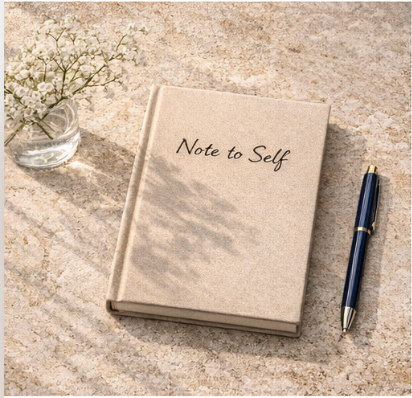
Telling joy apart from happiness takes noticing what actually grounds you over time — the Note to Self journal gives you a place to track it, one day at a time.