
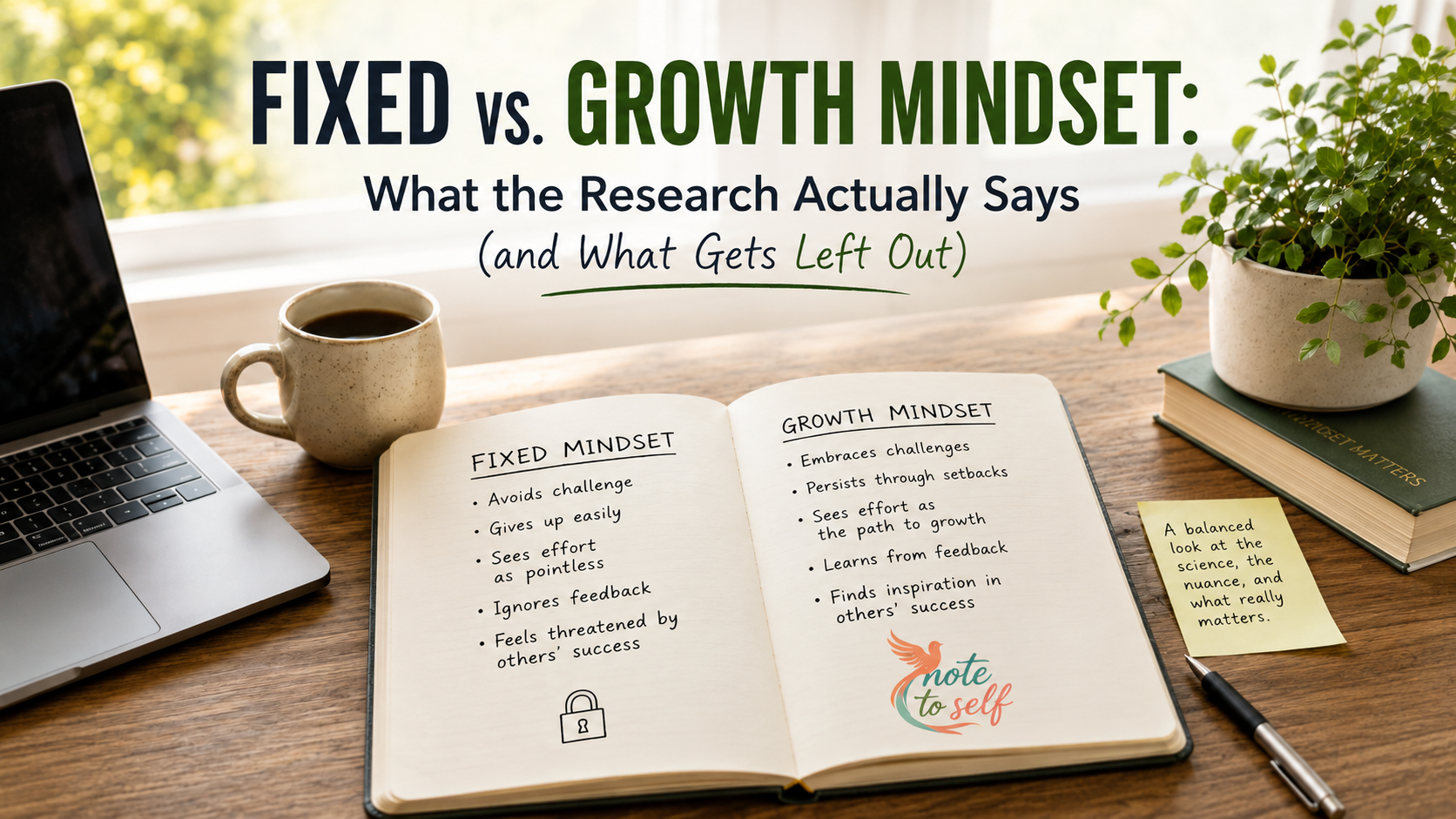
You have probably heard of the fixed versus growth mindset. It has become one of the most widely taught frameworks in education, leadership, and personal development over the past two decades. The summary version is simple: people with a fixed mindset believe their abilities are set, people with a growth mindset believe their abilities can be developed, and the second is better.
That summary is not wrong. But it is incomplete in ways that matter. And the incompleteness is part of why so many people learn about growth mindset, find it resonant, and then struggle to actually shift the areas of their life where they are most stuck.
Carol Dweck’s original research is more specific, more nuanced, and more useful than the version that tends to circulate. Understanding it correctly does not just tell you which mindset is preferable. It tells you where to actually look, and what to do when you find it.
What the Research Actually Found
Carol Dweck, a psychologist at Stanford, spent decades studying how people’s beliefs about their own abilities affect their behavior, performance, and resilience. Her central finding was that the belief a person holds about whether their abilities are fixed or developable has significant downstream effects on how they approach challenges, respond to failure, and persist through difficulty.
People operating from a fixed mindset tend to avoid challenges that might expose limitations, interpret effort as a sign of inadequacy, and give up more quickly when things get hard. Because the stakes of any performance are high — it is not just the task on the line, it is the verdict on your fundamental capacity — the safest move is often not to try.
People operating from a growth mindset tend to embrace challenges as opportunities to develop, interpret effort as a path to mastery, and recover more quickly from setbacks. Failure is not a verdict. It is data.
What made Dweck’s work particularly interesting was the mechanism she identified: it was not talent, intelligence, or past success that most reliably predicted resilience and growth. It was this single underlying belief about whether growth was possible at all.
“You can hold a growth mindset about your professional skills and a completely fixed mindset about whether you are lovable. Both beliefs are real. Both are shaping your life.”
The Part That Usually Gets Left Out
Here is what the popularized version tends to omit: mindset is domain-specific. Most people do not have a single, uniform mindset that applies to every area of their life. They have a growth mindset in some areas and a fixed mindset in others, sometimes in ways that are strikingly inconsistent.
A person can genuinely believe in their capacity to develop their professional skills, take on new challenges at work with openness, and persist through difficulty without self-judgment. That same person can carry a completely fixed belief that they are not someone who is naturally good at relationships, that social ease is something other people have and they do not, that they are, at a fundamental level, someone people find difficult to stay close to.
Both beliefs can be running simultaneously in the same person. And the growth mindset in one area does not automatically transfer to the other. The fixed mindset in the relationship domain will continue to shape behavior in that domain regardless of how growth-oriented the person is at work.
This is why telling yourself “just adopt a growth mindset” rarely produces meaningful change. If the fixed belief is operating in a specific domain, you need to find it there. Adopting a general attitude of growth-orientation does not reach the specific belief systems that are actually limiting you.
Where Fixed Mindset Hides
Fixed mindset beliefs tend to cluster in areas that feel most tied to identity and belonging. They are rarely about skills that are obviously learnable. They tend to be about worth.
You are likely operating from a fixed mindset in any area where you use language like: “I have always been this way,” “I am just not someone who,” “some people can do this but I cannot,” or “this is just how I am.”
They also tend to cluster in areas where the fear of failure feels disproportionately high. If missing a target at work produces frustration but you recover quickly, while receiving critical feedback in a close relationship sends you into a spiral that takes days to process, the difference in reaction is pointing at something. The stakes feel higher in one area because the belief about what failure means in that area is different.
A fixed mindset in an important domain tends to produce specific behaviors worth recognizing: avoiding the situation altogether, performing rather than being genuine, giving up earlier than the situation actually requires, and interpreting neutral information as negative evidence for the fixed belief.
If you recognize any of those behaviors in a specific area of your life, that is likely where the fixed belief lives.
Why the Praise for Intelligence Finding Matters
One of Dweck’s most striking findings came from a series of studies on how children were praised. When children were praised for being smart (“you are so intelligent”), they became significantly more likely to avoid challenges that might risk that identity. They chose easier tasks where success was guaranteed. When children were praised for effort (“you worked really hard on that”), they sought out more challenging tasks and persisted longer through difficulty.
The implications for adults are significant. If you grew up being identified as smart, talented, creative, or capable — if your identity was organized around a fixed quality rather than a developing capacity — you may be carrying the particular vulnerability of someone with something to protect. The talented person who underperforms on purpose. The intelligent person who avoids fields where they might be a beginner. The capable person who does not ask for help because needing it would threaten the identity.
Understanding where your self-concept was built around a fixed quality rather than a developing process is one of the more clarifying things you can do. It explains a lot about where you hold back and why.
What It Actually Looks Like to Shift
Shifting from a fixed to a growth orientation in a specific domain is not about telling yourself a more optimistic story. It is about changing what you believe is possible through accumulated experience and honest examination.
The first step is locating the fixed belief precisely. Not “I have a fixed mindset” in general, but “I believe that my capacity to be loved is fixed and finite, and I have had it since I was young.” The more specific the belief, the more workable it is.
The second step is examining the origin. Where did you learn that this particular thing about you was unchangeable? What experiences assembled that conclusion? Was it accurate then? Is it accurate now?
The third step is acting in deliberate contradiction. The belief loses credibility not through argument but through experience. Small, intentional acts that contradict the fixed belief, where you stay in the situation long enough to generate new data, are the actual mechanism of change.
None of this is fast. Fixed beliefs in core domains have usually been accumulating evidence for years. They do not dissolve quickly. But they do dissolve, with consistent, directed attention.
Reflection Prompts
- In which areas of your life do you genuinely believe you can grow? In which areas do you carry the quiet conviction that this is just how you are?
- Where do you use “I am just not someone who…” language? What does that sentence complete to?
- Think of an area where failure feels disproportionately threatening. What fixed belief about yourself is underneath that response?
- Were you praised more for what you were or for what you did growing up? How has that shaped what you protect?
- What would you attempt if you genuinely believed that capacity in this area could be developed? What has the fixed belief cost you in that domain?
The fixed versus growth mindset distinction is not about optimism versus pessimism. It is about what you believe is possible, in specific areas, based on specific evidence that was often assembled a long time ago.
Finding your fixed beliefs is not a comfortable process. But it is the most honest version of this work. Because you cannot shift a belief you have not located. And you cannot locate it if you are only looking for it in the areas where growth already feels easy.
The places where you stop yourself are exactly the places worth looking.
Noticing where a fixed story quietly runs your choices is its own practice — the Note to Self journal gives you somewhere to catch those moments and write your way toward a more flexible view.